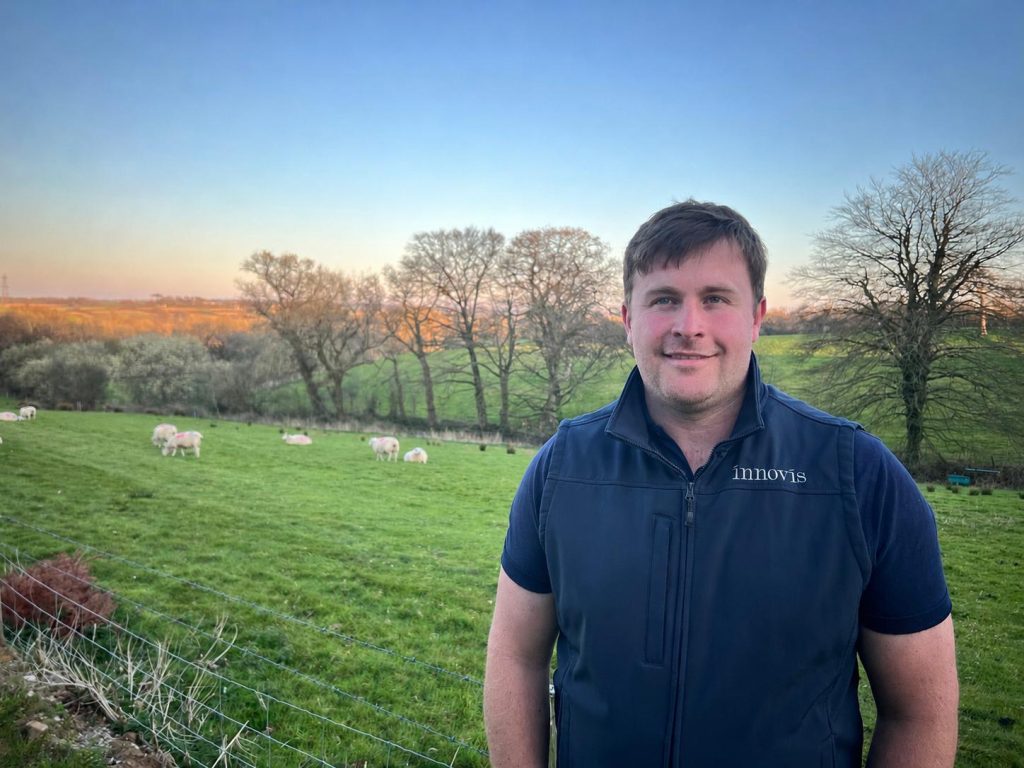
with thanks to Declan Marshall farming with father Alan, Holsworthy, Devon
Profitable, sustainable sheep farming is all about running a high output flock with minimal input, says Declan Marshall who has thoroughly tried and tested his commercial Highlander flock for almost two decades on a pure grazing system.
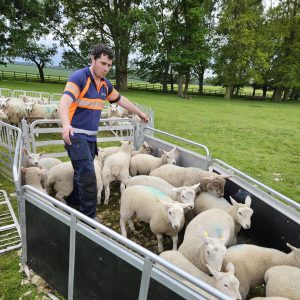
“Performance has been consistent,” he explains. “The entire flock is currently crossed to the Primera meat sire selected for ease of lambing and growth; we lamb outdoors in April and check twice a day. They lamb virtually unassisted over a very tight period – this year the vast majority was done and dusted in two weeks. The ewes have ample milk without any concentrate and they look after their lambs. Nowadays we’re sufficiently confident to leave a ewe to rear her three lambs.
“The flock is achieving an average 174% reared with the majority away by December. We’ve found it’s practical to run one ram with 80 ewes, while in an ideal world and we had bigger paddocks, I would put one to 100 ewes. Furthermore, these ewes maintain themselves 365 in BCS 3.0 to 3.5, and they’re hardworking, lasting for an average six crops.
“And the great thing about the Highlander – it has enabled us to achieve this level of performance simply from grass supplemented with minerals. We farm on very heavy clay which never burns up, not even in a dry summer, while our fields are typically five to eight acres, lending themselves to rotational mob grazing.”
Fact file
370 acres, plus additional grazing
450 Highlander ewe commercial flock
300 ewe Innovis nucleus flock – Highlander, Aberfield, Abertex and Aberglan
120 head dairy beef rearing unit
Declan and his father, Alan found their sheep farming enterprise was turned upside down back in 2008 when they agreed to swap their traditional Suffolk cross Mule flock for the Highlander. “We were amongst the pioneers to introduce these genetics from Innovis, then the Rissington Breedline company and later Focus Genetics. The Highlander had been bred in New Zealand where it had been ruthlessly selected for prolificacy, hardiness, narrow shoulders for ease of lambing, survivability and good forage conversion.
“Since the Highlander is a much smaller framed ewe maturing at an average 60kg, we were immediately able to more than double average stocking rate, indoor lambing became a thing of the past and we reduced overwintering costs by over 70% per ewe.
“Furthermore, the changes injected new confidence to not only maintain the enterprise, but more than double flock size to 800 ewes and achieve a necessary critical mass, invest in additional land whilst also upgrading general farm equipment and facilities. The new management system also freed up my time to such a degree, I no longer had to be a full-time working sheep farmer. Dad and myself work together during lambing and while recording, and nowadays I’ve sufficient time for additional off farm income splitting my year between scanning an annual 40,000 ewes and working with Innovis as south west technical advisor.
Ten years ago, Declan had the opportunity to develop an added value enterprise when he signed up as one of Innovis’s breeding partners, initially taking on a Highlander nucleus flock, before adding Aberfield and Abertex flocks and finally in 2023, the wool shedding Aberglan.
“These stud ewes and rams are managed in the same low input pure grazing system as the commercial Highlander flock, albeit slightly harsher, and they’re achieving an average 185% to 190% rearing rate,” he explains. “Lambs are routinely weighed and backfat scanned at various required intervals along with the ewes which are also body conditioned scored. We cull hard any lambs that do not meet Innovis’s strict specifications, and all singles are drafted to the commercial flock as well as ewe lambs for their first year – they have to lamb as a ewe lamb to be considered in the stud flock. Selected ram lambs are reared on and this year’s end game is scheduled to result in 80 shearlings for sale.”
| Commercial Highlander KPIs
200% scan 95% lamb within first cycle 174% reared 1 : 80 ram to ewes BCS 3.0 – 3.5, ave 365 6 lamb crops, ave 5 ram working seasons, ave |
He continues: “When I’m working off farm, I’m frequently asked questions particularly from farmers seeking to reduce inputs about ease of lambing through to finishing ability. Innovis has introduced immense selection pressure for these commercial traits, they’re recorded amongst large populations of sheep commercially farmed across different landscapes and tested in different systems. Overall, they’re properly recorded, so we can accurately predict how the sheep will breed.”
Declan adds: “I really enjoy what I do, running a busy, varied, profitable and sustainable business accompanied by the excitement of always breeding something better – rams and ewes that are more appealing to the eye and equally important, that have the accompanying data which reflects their potential performance.”