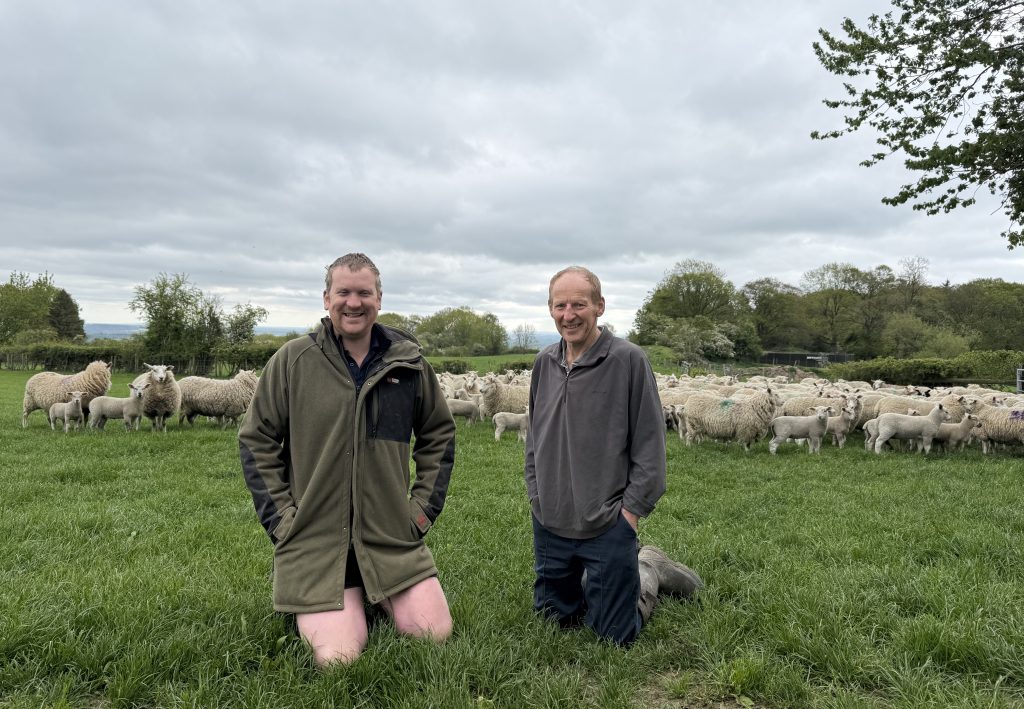
with thanks to Martyn Pryce who farms with his parents, David and Julie
Martyn Pryce lambed 500 Highlander ewes outdoors from late March onwards, 95% was complete within the first three weeks and judging from the crop he says he’s on target to achieve 175% reared off pure forage diets.
“We’re all about running a low input, high output profitable enterprise. Since introducing the Highlander, we’re producing 20% more lamb from the same area than we used to, we’ve cut feed costs by 80% because we reserve concentrate use only for extremes of weather, while we’ve made life a lot easier enabling both myself and Dad to spend more time working off farm,” he explains.
“I check the ewes twice a day during lambing, and then leave them to get on with it; in fact, they don’t like to be disturbed, particularly at night. Minimal intervention is required, so I’m able to manage the job virtually by myself. The lambs are sharp and quick to get up and suck and the ewes have plenty of milk, in fact sometimes they’ve too much.
“In 2025, Primera cross Highlander lambs were averaging 30kg at 10-week weaning, while the crop averaged 19.54kg deadweight, the majority graded within spec, and they were all away by 20 weeks.
Farm Facts
Broom Hill, Westbury, Shrewsbury
220 acres, marginal unit 800’ – 1,026’
500 Highlander flock inc150 ewe lambs
200 Continental and Continental cross ewes crossed to Abertex or Primera
32 pedigree beef breeding cows
10 commercial suckler cows
The Highlander ewes are lasting for an average four crops – they could last a lot longer, however we cull then so we can introduce better genetics. We’ve no hesitation to put one ram to 100 ewes and he’ll work for five seasons.”
Turn back the clock 10 years and the Pryce family ran an indoor lambing Cheviot Mule flock put to the Texel. Lambing was staggered over three to four periods extending from January through to May.
“The lambs were slower to get up, we were averaging 150% reared, up to 30% didn’t make 20kg target finishing deadweight by autumn and had to be sold in autumn, and we would put 30 to 40 ewes to one Texel tup and he’d last three to four seasons.”
Martyn continues: “I went on a three-month work experience trip to New Zealand where I shepherded on a 5,000-acre station with 5,000 composite ewes and 1,500 ewe lambs. It didn’t take me long to realise there was a more efficient and profitable way of managing a sheep enterprise.
“Back home and the Highlander offered the closest genetics I could find to the composites. Dad has always been open minded and said if you think it’s worth trying, then go for it, so that’s what we did. We went out and invested in our first Highlander ewes, we continued to buy in more when we could.”
Nowadays the flock is closed. The majority of the Highlander flock is bred pure with twin lambs retained for replacement purposes while the remaining Continental ewes are bred to the Abertex or Primera meat sires to rear an average 150% to 160%.
…we’re aware that the breeding decisions we make today are going to influence the flock for the next 10 to 15 years.
The Pryce family annually invest in one Highlander ram selected on EBVs – priority is given to milk, litter size and motherability together with fat for easier fleshing. “Innovis can accurately predict how the sheep will breed and we’ve proof the data works;” he says. “And we’re aware that the breeding decisions we make today are going to influence the flock for the next 10 to 15 years. We are breeding a lamb to sell deadweight, it doesn’t matter what it looks like, it’s all about profit,” Martyn comments.
“Once lambing and calving is over, both Dad and myself are away working off farm; he’s doing contract tractor driving while I’m shearing 6,000 head a year and doing various shepherding. Mum stays home and holds the fort.”
David continues: “Post weaning, lambs continue on a rotational paddock grazing system, while the ewes are drafted to poor grazing. During winter they remain outdoors grazing fodder beet and turnips.”
He adds: “The most costly saying any farmer can make is ‘we’ve always done it this way’, when we’d say never be afraid to try something different. Martyn’s trip to New Zealand inspired us to introduce the Highlander which has enabled us to future proof this unit for the foreseeable future.”